Bambu Lab A2L: A Large-Format Printer at Entry-Level Money
The new Bambu Lab A2L brings a 330 x 320 x 325 mm bed to the A-series for $469. Full specs, what it is good for, the trade-offs, and whether it makes sense for selling prints.
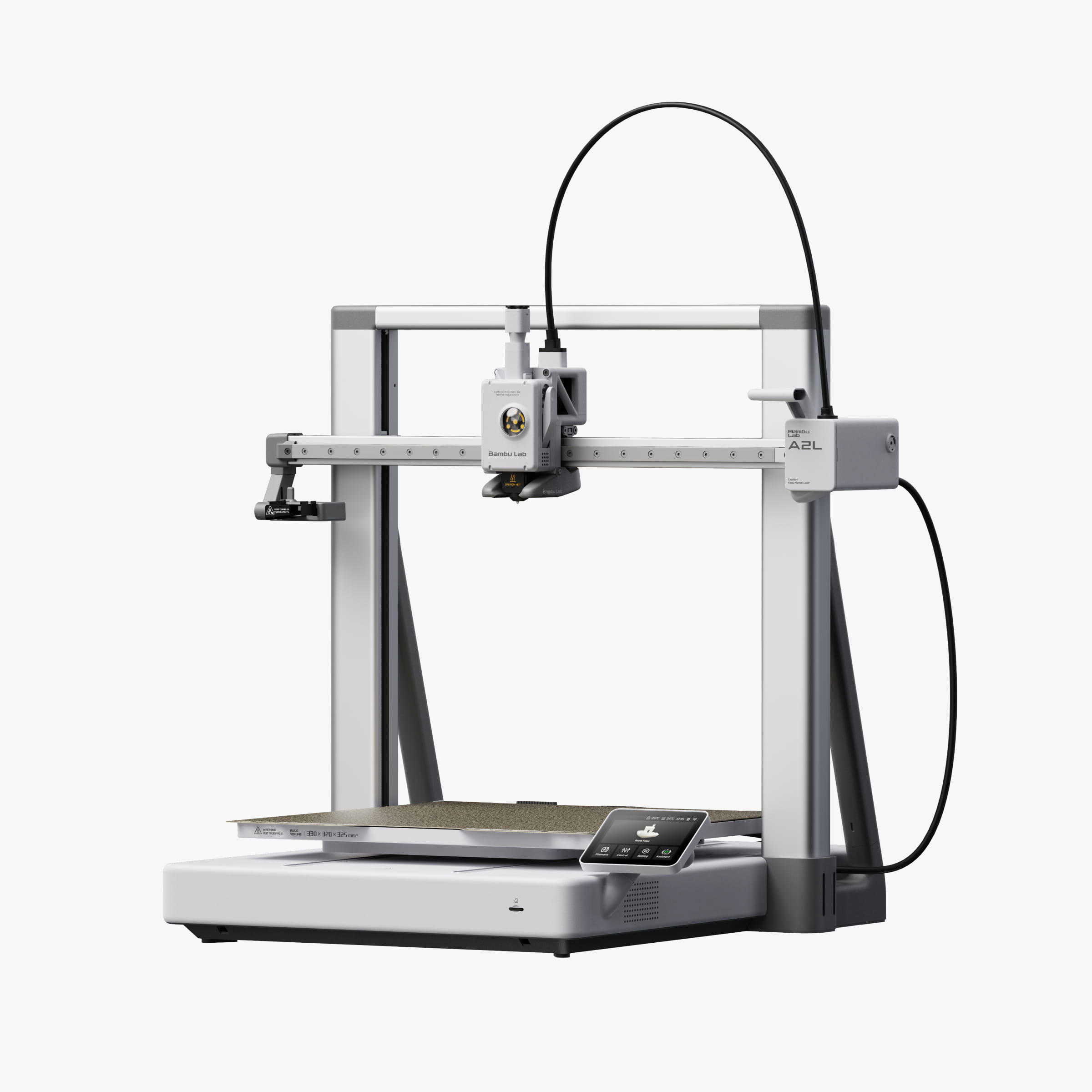
Bambu Lab shipped the A2L on June 1, 2026, and the story is one number. It has the same 330 x 320 x 325 mm build volume as the 1,899 H2D, and it costs 469. That is a large-format Bambu bed at entry-level money, and for anyone selling prints it quietly changes what "the cheap machine" can actually make.
See our volume comparison of the A-Series
To scale, nested.
Each box is a printer's real build volume, sharing one corner. Slide to grow through them — drag to orbit.
The A2L is not a successor to the A1 and not a replacement for it. It is a new category in the A-series: a large, open-frame bed-slinger aimed at projects that used to be split into pieces and glued back together. Below is what it is, what it is genuinely good for, where it falls short, and whether it earns a place in a print shop.
The specs that matter
| Bambu Lab A2L | |
|---|---|
| Type | Open-frame Cartesian bed-slinger |
| Build volume | 330 × 320 × 325 mm (about 34.3 L, 105% more than 256 mm-class machines) |
| Price | 469 standalone / 569 Combo (with AMS Lite). EU: about 379 / 489 |
| Nozzle | Single, stainless steel, up to 300 °C, sizes 0.2 / 0.4 / 0.6 / 0.8 mm |
| Bed | Up to 80 °C, flexible textured PEI plate (plus Engineering and Cool Plate SuperTack options) |
| Multi-colour | Up to 19 colours via 4 AMS plus 1 AMS Lite in series; AMS Lite included with the Combo |
| Motion | Closed-loop servo motor, Adaptive Vibration Compensation (a first for the A-series) |
| Extras | Optional blade Cutting Module and Pen Module, hands-free calibration, touchscreen, MakerWorld access |
| Noise / air | Under 49 dB in Silent mode; UL 2904 GREENGUARD certified for indoor air quality |
| Available | Shipping globally since June 1, 2026 |
Day-one reviews report what you would expect from Bambu: excellent print quality straight out of the box, with one tester running a Benchy in 38 minutes with no visible ringing. The closed-loop servo and vibration compensation are features that used to live in Bambu's pricier machines, which is why some are calling the A2L an "H2S Lite."
What it is good for
For a print business, a big bed is not just about big parts. It pays off in two ways.
Large single-piece prints. Cosplay helmets and props, signage, oversized decor, and large prototypes that a 256 mm bed forces you to slice into sections. Printing them in one run means no seams to glue, fill and sand, which saves real post-processing time and gives a cleaner product. Our guide to what sells on Etsy covers several of these niches, and the A2L removes the size ceiling on them.
Batch production. This is the one sellers underrate. A 330 x 320 mm bed fits a lot of small items per plate. If your shop sells keychains, articulated toys, jewelry or miniatures, you can lay out a full plate and print twenty in one unattended run instead of babysitting four separate jobs. More parts per plate is more throughput per day, which is the lever that actually grows a small shop.
Add the AMS Lite (the 569 Combo) and you get automatic multi-colour, which unlocks the multi-colour toys, signs and figures that sell well. For a seller, the Combo is usually the version to buy, because the 100 step up is the cheapest entry into multi-colour Bambu has offered.
The print-and-cut angle
The A2L has a trick the rest of the A-series does not: optional craft tools. A blade Cutting Module cuts stickers, vinyl, leather, fabric and paper, and a Pen Module draws and writes. For an Etsy seller that means one machine can print products and also produce vinyl decals, paper craft and pen-plotted cards, which is a genuine way to widen a product line without buying a separate cutter. Note that there is no laser module, and a full "print-then-cut" workflow is still in development, so treat the craft tools as a useful bonus rather than the main reason to buy.
The trade-offs
The A2L buys size, and the price of that size is the enclosure. This is the thing to understand before you spend:
- Open frame, so no heated chamber. With a single nozzle and an 80 °C bed, the A2L is firmly a PLA, PETG and TPU machine. ABS, ASA, PC and nylon want an enclosed, chamber-heated printer and are not its lane. If your products need tough or outdoor-grade engineering materials, this is the wrong Bambu. Our filament guide explains which material suits which job.
- A big moving bed. As a bed-slinger, the whole large bed shuttles back and forth. That needs desk space around it, and very tall, thin prints can be more prone to wobble at high speed than they would be on a CoreXY machine.
- Single nozzle, no laser. Despite pre-launch rumours, the final machine is single-nozzle with no laser engraving.
A2L vs A1 vs P2S: which Bambu
Three Bambu machines sit near this price, and they solve different problems:
| A1 (Combo) | A2L (Combo) | P2S | |
|---|---|---|---|
| Approx. price | ~399 | 469 / 569 | ~550 |
| Build volume | 256 × 256 × 256 mm | 330 × 320 × 325 mm | 256 × 256 × 256 mm |
| Frame | Open | Open | Enclosed |
| Best lane | Everyday PLA/PETG/TPU | Large parts and batch runs | Engineering materials (ABS, ASA, PC) |
The real decision is size versus material range. If you print large or in batches and live in PLA and PETG, the A2L is the pick. If you need an enclosure for tougher materials and can work within a 256 mm bed, the enclosed P2S is the better fit. The A1 remains the cheaper everyday all-rounder for smaller work. For the wider budget picture, see our guide to the best budget printer to start selling.
Is it worth it for selling prints?
If your products are large, or you batch-produce small items, and you work in PLA, PETG and TPU, the A2L is one of the most compelling value buys Bambu has shipped: a near-H2D footprint for a fraction of the price, with the reliable, low-fuss experience that keeps your failure rate and wasted filament down. Buy the 569 Combo for the multi-colour, since that is where the large bed earns its keep.
If you mainly print small single items, the cheaper A1 covers you. If you need engineering materials, look at an enclosed machine instead. As with any printer, the bigger bed only pays off if you price the prints properly. A larger plate means longer runs and more filament per job, so the cost per piece, and your quote, move with it.
That is where the running costs come in. A big batch print still costs you filament, electricity, machine wear and the share of failed prints, and on a long plate those numbers matter more, not less. Set the A2L's power draw and wear rate once, and our guide on how to price 3D prints walks through the full formula so each job, large or small, is priced to keep its margin.