PLA vs PETG vs ABS vs TPU: The Filament Guide for People Who Sell Prints
PLA, PETG, ABS and TPU compared the practical way: what each material is, what it is good for, what to print with it, and which brands are worth buying.
If you price prints for customers, the filament you load is not just a quality decision. It is a cost decision and a "will this part survive the customer" decision. A coaster does not need the same plastic as a bracket that lives in a hot car.
This guide covers the four materials that handle almost every job that walks through the door: PLA, PETG, ABS and TPU. For each one you get the short version of what it is, what it is good at, what to actually print with it, and which brands are worth your money. There is a quick comparison first, then the detail.
The 30-second comparison
| PLA | PETG | ABS | TPU | |
|---|---|---|---|---|
| Nozzle temp | 190 to 220 °C | 230 to 250 °C | 230 to 260 °C | 220 to 235 °C |
| Bed temp | 50 to 60 °C | 70 to 85 °C | 90 to 110 °C | 40 to 60 °C |
| Enclosure | No | No | Yes (and ventilation) | No |
| Difficulty | Easy | Medium | Hard | Medium to hard |
| Heat resistance | Low (softens ~60 °C) | Medium | High | Medium |
| Flexibility | Stiff, brittle | Stiff, tougher | Tough | Rubber-like |
| Outdoor / UV | Poor | Decent | Needs ASA instead | Good |
| Best for | Looks, prototypes, indoor parts | Functional parts, food contact | Heat and impact parts | Flexible and grippy parts |
Two practical notes before the detail. First, PLA is stiffer and prints sharper than most people expect. Independent bending tests have repeatedly shown basic PLA holding its shape better than PETG or ABS, so "stronger" is not a single number. Second, almost every material here except PLA absorbs moisture from the air, which wrecks print quality. A cheap bag of silica gel in a sealed box prevents more failed prints than spending extra on the spool itself.
PLA: the default for a reason
What it is. Polylactic acid, made from renewable sources like corn starch. It is the most printed filament in the world and the easiest to live with.
What it is good at. It prints at low temperatures, barely warps, sticks to almost any bed, and gives you clean detail and sharp edges. It is also the cheapest to run and the most forgiving when a print fails, which matters when you are quoting tight margins.
What it is not good at. Heat. PLA starts to soften around 60 °C, so anything that sits in a sunny window, a car, or near electronics is a bad fit. It is also rigid and somewhat brittle, so it snaps rather than bends under a sharp load.
Print this with it. Display pieces, miniatures, prototypes and fit checks, signage, toys, organisers, and any indoor part where looks matter more than mechanical stress. For a print shop, PLA is your bread-and-butter material for decorative and one-off jobs.
Brands worth buying.
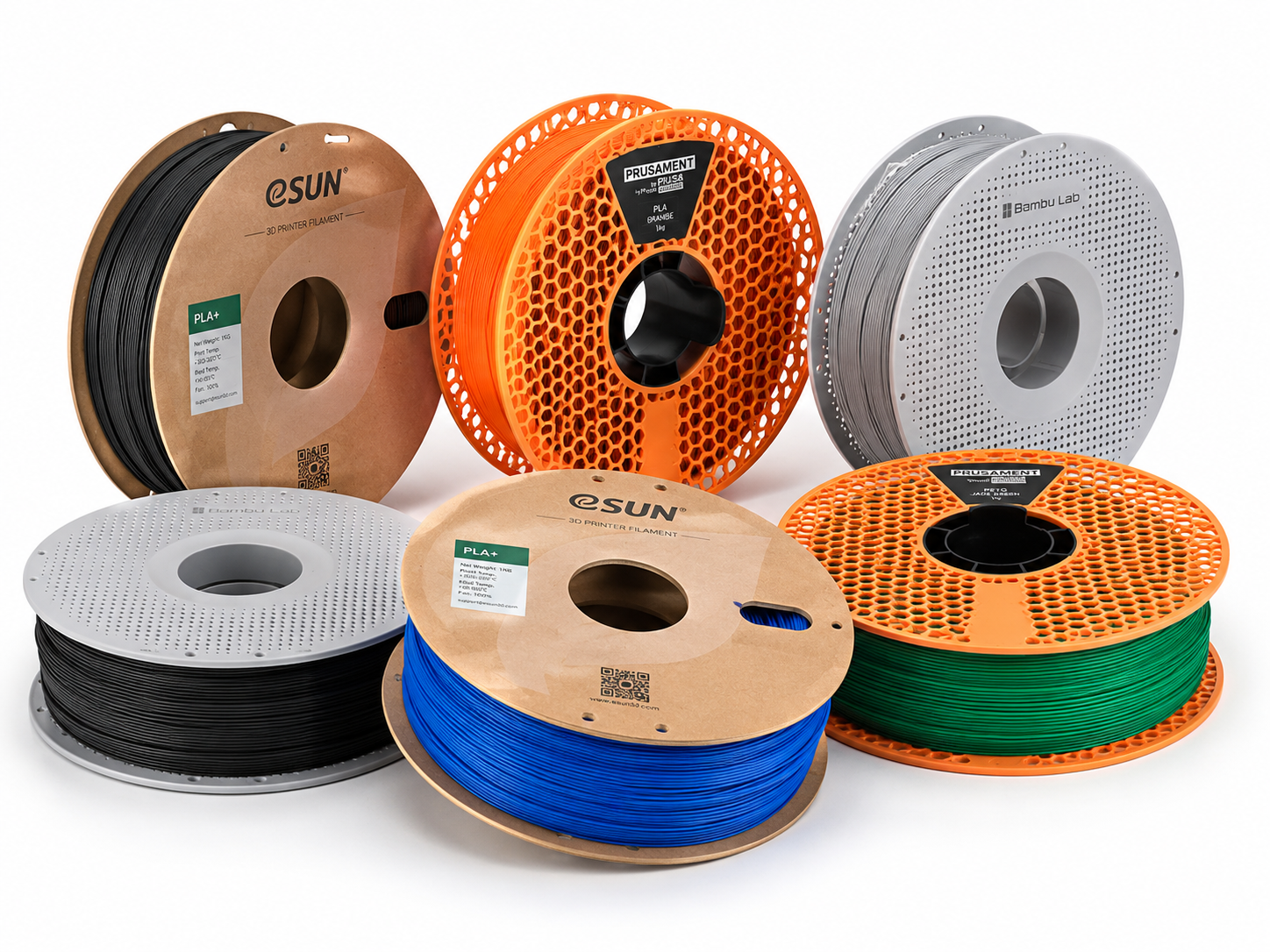
- Prusament PLA if you want the tightest tolerance on the market (around plus or minus 0.02 mm) and the fewest surprises. Buy · Prusament
- Polymaker PolyLite / PolyTerra PLA as the best all-round pick: near-premium consistency at a mid-range price, and PolyTerra is the matte, eco-leaning line. Buy · Polymaker
- Overture PLA as the value champion. Vacuum sealed with desiccant, tight diameter, low price, great for bulk. Buy · Overture
- eSUN PLA+ when you want a tougher, less brittle PLA for functional-ish parts without moving up to PETG. Buy · eSUN
PETG: the functional workhorse
What it is. Polyethylene terephthalate glycol, the same family as plastic bottles. It sits between PLA and ABS: most of PLA's printability with a real step up in toughness and chemical resistance.
What it is good at. It is tougher and less brittle than PLA, resists water and many chemicals, handles more heat, and has food-safe variants. It holds up outdoors far better than PLA. Clear and translucent PETG also stays glossy and see-through, which PLA struggles with.
What it is not good at. It is fussier to dial in. PETG loves to string and ooze, and it absorbs moisture aggressively, so it usually needs drying before a clean print. It also bonds very hard to some build plates and can chip a PEI sheet if your Z-offset is too low, so use a release agent or a textured plate.
Print this with it. Functional and mechanical parts, brackets, enclosures, outdoor fixtures, planters, food-contact items (with a food-safe spool and the usual caveats about porous prints), and anything a customer will actually put under stress. For a shop, this is the material you reach for when the part has a job to do.
Brands worth buying.
- Prusament PETG for premium consistency and low stringing out of the box. Buy · Prusament Orange
- Overture PETG for reliable, affordable functional prints. Buy · Overture
- Polymaker PETG when you want low stringing and clean winding for an enclosed feed. Buy · Polymaker Dark Grey
- Atomic PETG Pro if a customer wants strong colours and a cleaner finish.
ABS (and its better-behaved cousin ASA): heat and impact
What it is. Acrylonitrile butadiene styrene, the plastic in LEGO bricks and car interiors. ASA is the close relative you should usually choose instead for anything outdoors, because it adds proper UV resistance.
What it is good at. Real heat resistance, strong impact toughness, and it can be vapour-smoothed with acetone to a glossy, injection-moulded look. That smoothing trick is genuinely useful for customer-facing parts.
What it is not good at. Printing. ABS warps badly as it cools, so it wants an enclosed printer with a hot bed (90 to 110 °C) and stable temperatures. It also gives off fumes, so ventilation is not optional. If you are quoting ABS for a customer, factor in a higher failure rate and the enclosure requirement.
Print this with it. Automotive and engine-bay parts, electronics housings, tool handles, parts that need acetone smoothing, and anything exposed to sustained heat. Reach for ASA instead when the part lives outside in the sun.
Brands worth buying.
- Polymaker PolyLite ABS / ASA for consistency and lower warp. Buy · Polymaker
- eSUN ABS+ as a tougher, slightly easier-printing budget option. Buy · eSUN
- Prusament ASA when UV stability and tolerance both matter.
TPU: the flexible one
What it is. Thermoplastic polyurethane, a rubber-like filament. It is sold by hardness, measured on the Shore scale. 95A is the common, easier-to-print grade; softer grades flex more but print slower and fussier.
What it is good at. Flex, stretch, grip and shock absorption. It bends and compresses repeatedly without losing shape, which no rigid plastic can do. It also resists UV and abrasion reasonably well.
What it is not good at. Speed and ease. TPU prints slowly, usually wants a direct-drive extruder rather than a Bowden setup, and is hygroscopic enough that drying before printing is normal practice. Quote it with extra print time built in.
Print this with it. Phone cases, gaskets and seals, vibration dampers, wheels and tyres, grips, watch straps and other wearables, and protective bumpers. For makers in the drone and RC space, TPU is the standard for soft mounts and camera protection.
Brands worth buying.
- NinjaTek (Cheetah, Armadillo) as the specialist standard for TPU.
- Polymaker TPU for consistent batch-to-batch quality.
- eSUN eTPU-95A as a reliable, affordable starting point.
Where brand quality actually comes from
When people say one filament is "better," they usually mean one of three things:
- Diameter tolerance. Premium brands like Prusament hold around plus or minus 0.02 mm; good value brands sit near 0.03 mm. Tighter tolerance means more consistent flow and fewer surface defects, which matters most on long prints and visible parts.
- Moisture protection out of the box. ColorFabb's double-barrier foil bags are close to impermeable, Overture and eSUN ship vacuum-sealed with desiccant, while basic plastic bags from budget brands often need drying before first use.
- Spool and feed quality. Plastic spools feed reliably; cardboard spools are greener but can swell in humidity and shed fibres, which is a real consideration if you run a multi-material system.
A rough hierarchy that holds up across most tests: Polymaker is the safest all-round buy, Prusament is the premium quality-control pick, Bambu Lab is the plug-and-play choice if you run their printers and AMS, and Overture, eSUN and Sunlu cover the value end. ColorFabb and Fillamentum are where you go for specialty colours and engineering grades. Many of these are easy to source in Europe, which matters if you do not want to wait on overseas shipping.
Quick decision guide
- New to printing, or it just needs to look good indoors? PLA.
- It has a real job and might live outside? PETG.
- It needs to survive heat or hard knocks? ABS, or ASA if it sees sun.
- It needs to bend, grip or absorb shock? TPU.
For a print business the simplest stocking strategy is PLA plus PETG to cover the large majority of jobs, then keep TPU on hand for flexible work and ABS or ASA for the occasional heat-resistant order.